The market has shifted. And most aspiring engineers haven't noticed.
Five years ago, companies hired for potential. "You can code? Great, we'll train you." There was patience. There was a runway. You got hired as a junior, and the company invested in your growth.
That world is gone. Here’s what a Meta Recruitment Program Manager said last week
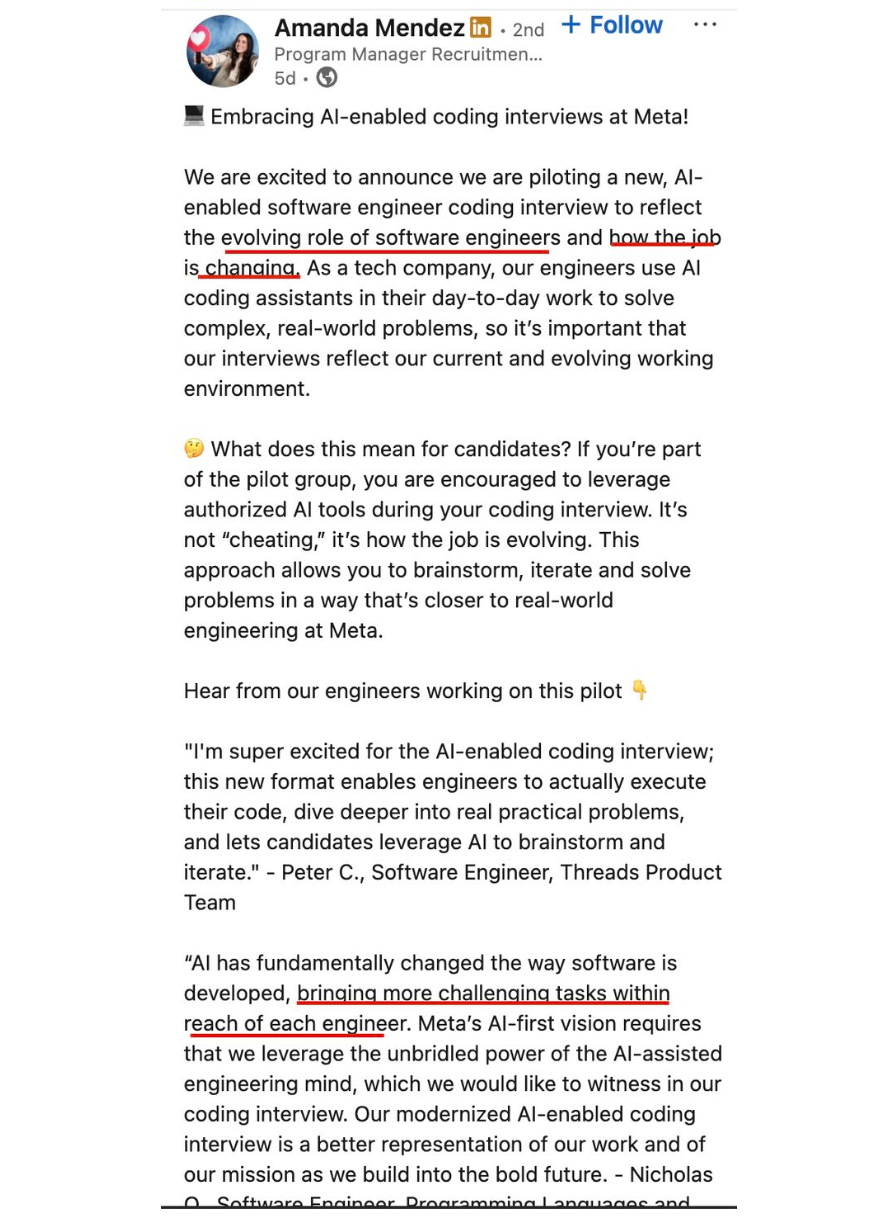
Meta announcing AI-enabled coding interviews… sounds encouraging, right? More tools to help you prepare.
Actually, it's making things worse.
Today, companies hire for velocity. They want engineers who ship. Not engineers who will learn to ship. Engineers who do it now.
A CEO at Scale AI put it bluntly in a recent episode of Lenny’s Podcast: in fast-moving markets, companies hire for speed.
I paraphrase but you get the gist.
And he's right. Look at Anthropic—they're doing 5 releases per engineer per day. Not per week. Per day.
That's the new baseline.
Where does this leave you?
If you've been self-studying for 12+ months, you're still in learning mode. You can probably code. You might even understand data structures and algorithms reasonably well.
But you can't ship. Not at speed. Not consistently. Not under pressure.
And that gap just got monumentally wider.
Why AI Made This Worse
Here's the cruel irony: AI was supposed to help beginners catch up.
AI is an accelerant for established engineers. They use it to ship faster, debug faster, refactor faster. They're already confident. AI amplifies their speed.
For beginners? AI is a gap-widener. You think "Oh, I can use ChatGPT to write code for me," so you skip understanding the fundamentals. Then you hit a problem ChatGPT can't solve, and you're stuck. Meanwhile, the experienced engineer uses AI as a tool because they already know when and how to use it.
You doubled your speed from 10mph to 20mph. Experienced coders go from 100mph to 600mph.
The gap didn't narrow. It exploded.
The Real Problem Isn't Learning Code
This is the hard truth: If you're still focused on "learning to code," you've already lost the race.
Learning syntax, understanding data structures, and grinding Leetcode—these were the bottlenecks in 2015. They're not anymore.
The bottleneck is everything after you can write code:
-
Can you scope a problem correctly (this is critical to problem-solving)?
-
Can you break down a vague requirement into concrete steps (this is critical to problem-solving)?
-
Can you anticipate what will break when you deploy (this separates developers from engineers)?
-
Can you write code that other people can understand and maintain (this separates developers from engineers)?
-
Can you ship something imperfect and iterate (this separates good coders from effective coders)?
-
Can you make trade-off decisions under uncertainty (this separates coders from product builders)?
And all these separate coders who get hired from people who know “learned to code”.
And these are the things nobody teaches in bootcamps or tutorials.
The Stuck Intermediate Trap
You've probably been here: 12 months of self-study. You can build a todo app. You understand loops and functions. You've done some projects.
But you can't get interviews.
And when someone suggests you "do more projects" or "grind more DSA," you feel the trap closing. Because you sense—correctly—that the problem isn't your coding ability.
The problem is: You don't know how to think like an engineer.
An engineer looks at a problem and thinks: "How do I ship this in the fastest, most maintainable way?" A learner looks at a problem and thinks: "How do I make this work?"
These are different mindsets. And you can't learn one by watching YouTube tutorials about the other.
What Actually Matters Now
If companies are hiring for speed, and AI has commodified syntax, here's what actually determines whether you get hired:
1. Shipping Mentality
Can you take an ambiguous requirement and ship something in a day? Not perfect. Good enough to get feedback on.
Most self-taught engineers can't. They're stuck in the "build it perfectly" mindset. They overthink. They refactor. They never deploy.
Experienced engineers have shipped enough times to know: shipping a 70% solution today beats a 95% solution next week. You get feedback, you iterate, you move.
Start practicing this. Build small projects with hard deadlines. Ship things that aren't polished. Deploy to production even if you're nervous. This is a learnable skill.
2. Problem Decomposition
When a senior engineer hears a vague requirement, they immediately start asking questions:
-
What's the success metric?
-
Who's the user?
-
What happens if this breaks?
-
What's the simplest version of this that delivers value?
-
What can we defer?
This is not taught in coding courses. But it's what gets you hired.
Start thinking in constraints. Every project you work on, explicitly define: time budget, complexity budget, and scope boundaries. Then solve within those constraints. This trains your brain to think like someone who ships.
3. System-Level Thinking
Beginners write code. Engineers build systems.
A beginner writes a function that works. An engineer asks: How does this function fit into the larger picture? What breaks if I change this? How will someone else maintain this?
This requires experience. But you can accelerate it by studying real codebases. Not tutorials. Real, messy production code.
Look at open-source projects. Read how experienced engineers structure things. Notice the patterns. Notice why they made certain trade-offs.
This is where you learn to think like someone who's shipped at scale.
4. Communication as a Core Skill
Here's what will shock you in your first engineering job: 60% of the work is explaining your decisions to people who don't code.
Why did you choose this approach? What's the trade-off? Why not that other solution? How does this impact the product?
Most self-taught engineers can't do this. They can code, but they can't communicate about code.
Start practicing now. For every project you build, write a short document explaining:
-
The problem
-
Your approach
-
Why did you choose it over alternatives
-
What could go wrong
-
What you'd do differently next time
This is not busywork. This is the skill that gets you hired.
5. Understanding Business Context
Engineers who get hired fast understand why the code matters.
Not just the technical requirements. The business problem. The user problem. The competitive angle.
When you're learning, code feels abstract. You're solving algorithmic puzzles. You're building projects because tutorials tell you to.
Real engineers connect code to outcomes. They ask: "Who uses this? What does it do for them? Why does it matter?"
Start asking these questions about every project. If you're building a tool, who's the real user? What problem does it solve for them? What would they be willing to pay for?
This changes how you code. It changes the projects you choose. And it makes you hireable.
The Competitive Disadvantage You Don't See Yet
Right now, you're competing against:
-
CS graduates with structured training in shipping
-
Self-taught engineers with years of production experience, because they got in at an easier time
-
Established engineers who use AI to move faster than ever
You have one advantage: You can beat the market if you focus on the right things.
But you have to stop optimizing for "learning more code" and start optimizing for "shipping products."
Most aspiring engineers are still doing the former. The ones who break through do the latter.
What to Do Starting Today
-
Ship something small this week. Not perfect. Just deployed.
-
Read real code. Spend 2 hours reading a production codebase. Notice patterns. Notice decisions. Ask why.
-
Stop grinding DSA. Seriously. If you can't get interviews, DSA isn't your problem. Focus on projects and communication instead.
-
Document your thinking. For every project, write down your approach, your trade-offs, and why you chose what you chose.
-
Talk to people who ship. Not influencers. Engineers who actually work at companies. Ask them: What do you look for in junior engineers? What do they get wrong?
-
Build in public. Share your projects. Explain your decisions. Get feedback. Iterate. This trains you to think and communicate like a shipped engineer.
The Speed Gap Is Real
The market has moved. Companies aren't hiring for potential anymore. They're hiring for speed.
AI isn't going to close the gap for you. It's going to widen it unless you understand what actually matters.
Learning to code was stage 1. You're past that.
Stage 2 is learning to ship. Learning to think in systems. Learning to communicate. Learning to make trade-offs under uncertainty.
That's what gets interviews. That's what gets hired.
And that's what nobody teaches you until you figure it out yourself.
The question is: Will you figure it out before the gap closes completely?
Four ways we can help you:
1. Wondering what learning to code actually means?
Becoming a coder is much more than just "learning to code" some languages. When I got hired at Google, for example, I didn't know 3 out of the 4 languages I had to write every day.
Check out
👉 My FreeCodeCamp Course on YouTube --> Before You Learn To Code (Video).
👉 Updated version (including Google and other big tech experiences)
2. Inner Circle (Free Preview Included)
Our personalized, intensive mentorship program is designed to help career changers go from zero to software developer—and actually get hired. It’s not for everyone, but if you’re ready to commit, we’ll walk with you every step.
👉 Preview the Inner Circle Program -> free preview.
👉 Apply for Future Coders Inner Circle → https://www.matchfitmastery.com/inner-circle
3. Career Change To Code Podcast
Driving? At the gym? Hiding in the bathroom? Perfect time to inject the best techniques for a career change to code directly into your brain via
👉Drip tips directly into your brain with the Easier Said Than Done podcast: YouTube | Spotify
4. Weekly Tips In Your Inbox
👉 Subscribe to this newsletter (it’s free). I try and keep it to 3 minutes or less so you can read in the elevator, waiting in lines, in the bathroom...😝